ISJS REPRESENTATION AT INTERNATIONAL CONFERENCE ON ANEKĀNTAVĀDA
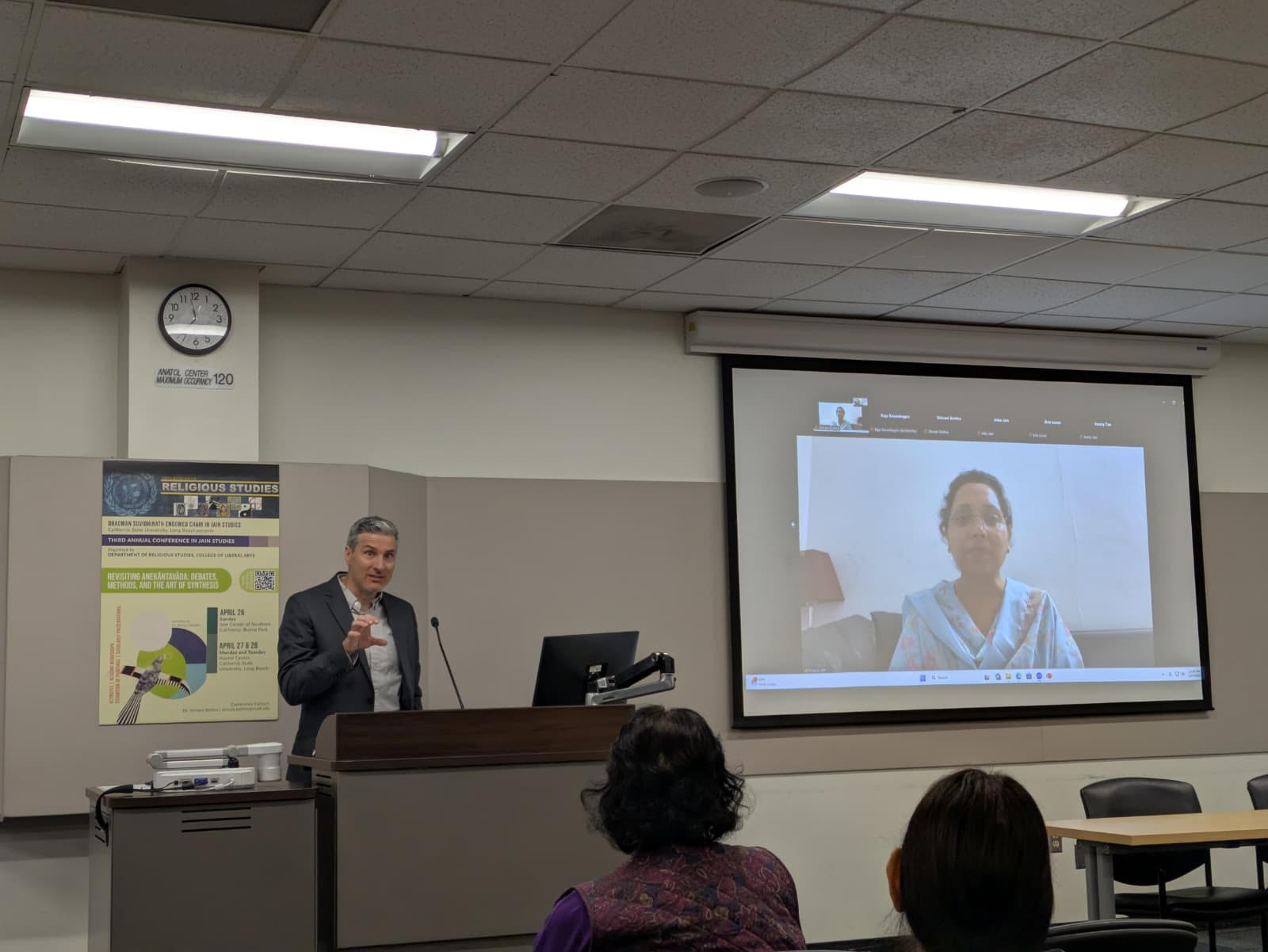
ISJS Research Associate Ms. Pragya Jain presented her paper titled “How to Make the Most of This Era: An Anekāntic View of Dharmya Dhyāna” at the international conference Revisiting Anekāntavāda: Debates, Methods, and the Art of Synthesis. The conference was organized by the Bhagwan Suvidhinath Endowed Chair in Jain Studies at the Department of Religious Studies, California State University, Long Beach.
In her presentation, Ms. Jain explored parallels between cognitive psychology and Jain philosophy, drawing on the Cocktail Party Effect to illustrate selective attention and connecting it with Jain concepts of dhyāna. She emphasized the distinction between inauspicious forms of meditation (ārta and raudra) and auspicious forms (dharmya and śukla), highlighting dharmya dhyāna as the most accessible and transformative practice in the current era.
The abstract of her paper follows:
The Cocktail Party Effect (Cherry, 1953) illustrates selective attention in cognitive psychology, showing how we filter noise to remain absorbed in a chosen stimulus. Jain philosophy parallels this with dhyāna, where practitioners consciously withdraw from distractions to focus on the soul. Unlike psychology, Jainism emphasizes not only the process (dhyāna) but also the object of focus (dhyeya), the efficiency of the practitioner (dhyāta) and the desired outcome (phala) distinguishing between the two forms of dhyāna. While the inauspicious dhyāna – sorrowful (ārta) and wrathful (raudra) – leads to harmful outcomes, including subhuman and hellish existences, auspicious dhyāna – pious (dharmya) and pure (śukla) – results in beneficial outcomes such as heavenly abodes and liberation. Since the first two are undesirable, and liberation is considered unattainable in the current era, the only accessible form is dharmya dhyāna that involves reflections as well as visualization, and mantra recitation. Looking for the ideal form of meditation, Arthur Koestler (1960) observed that mere repetition of “a-rose-isa-rose-isarose” (Stein, 1913) does not yield the fruits of meditation, stressing the need for a deeper foundation. The Jñānārṇava (11th century CE) insists on establishing spiritual awakening (samyagdarśana) before engaging in chanting or visualization, and then depicts the efficacy of disciplined meditation on the self through diverse techniques. Therefore, when mechanical repetition proves spiritually barren, direct engagement with self-realization becomes indispensable. Only an anekāntic approach allows dhyāna to be transformative rather than habitual.
Ms. Jain spoke on Day 2, Panel One: Anekāntavāda in Practice, moderated by Prof. John Becker of California State University, Long Beach. Fellow panelists included Dr. Brianne Doldson (University of California, Irvine), who presented on “Pluralizing the Event of Cross-cultural Medical Care through Jain Many-Sidedness”, and Dr. Andrew Bridges (California State University, Fullerton), who discussed “Anekāntavāda and its Relevance for Contemporary Descriptions of Existence: An Examination of the Utilizations of the Elephant Illustrations in Comparative Anthropology and Philosophy of Science.”
The three-day conference featured multiple sessions, diverse panels, and an exhibition of paintings by Dr. Manju Nahata, offering a rich platform for scholarly exchange on Jain philosophy and its contemporary relevance.
Email: info@isjs.in | Website: www.isjs.in